Governance and Public Sector Reform in Asia by Anthony Cheung Ian Scott
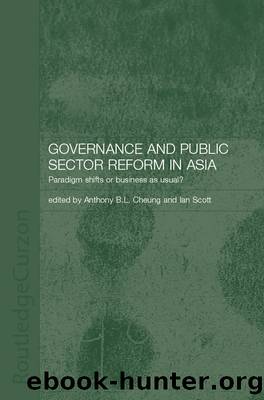
Author:Anthony Cheung, Ian Scott [Anthony Cheung, Ian Scott]
Language: eng
Format: epub
ISBN: 9781138862869
Barnesnoble:
Publisher: Taylor & Francis
Published: 2015-03-04T00:00:00+00:00
Administrative and Social Context
Malaysiaâs system of government consists of the federal government, thirteen state governments, four municipalities (namely Penang, Ipoh, Kuala Lumpur and Malacca), non-financial public enterprises (NFPEs), public financial institutions such as the Employee Provident Fund (EPF) and the Bumiputra Investment Foundation, plus other government companies. The federal government is responsible for defence, external affairs, internal security, citizenship, civil and criminal law, finance, commerce and industry, shipping, communications, health and labour. Sixty-five government departments serve twenty-five ministries. Overall, the federation is highly centralised, with the federal government accounting for about 80 per cent of public spending (Halligan and Turner 1995: 73).
The public sector is an important provider of employment, goods, services, investment and management of the economy. Consequently, Malaysia has one of the largest public sectors among countries at a comparable level of economic development, which is also larger than average economically âadvancedâ countries (Osman-Rani 1996: 24). The Malaysian political leadership has expended much energy in portraying the civil service as an extremely capable institution. Government publications make frequent references to âparadigm shiftsâ in connection with the public service.
The colonial legacy remains strong and continues to influence the structure of its system of public administration. Thus the civil service remains a âpolitical bureaucracyâ that makes policy and maintains law and order. Sarji described the British legacy as a âcontrol administrationâ and power is centralised (Sarji, interview, 11 February 1999). In particular, power is concentrated in the central agencies, especially the Public Service Department, the various service commissions and the Treasury. Generalists hold key posts in each ministry, with the Malaysian Administrative and Diplomatic Service controlling the operating departments. This emphasis on strong central control is a feature of the colonial administrative style and also contributes to the highly centralised structure. Furthermore, the elitist nature of the public service has been preserved. Crouch (1996: 17) pointed out that long before independence, âthe British set out to create an English-educated administrative class recruited from the Malay aristocracy; and members of this class filled the highest echelons of the bureaucracy after independenceâ (Puthucheary 1987).
Despite the persistence of colonial structures and practices, there has been a push since independence for a distinctive Malaysian public service. The dominance of UMNO since 1963 eventually resulted in âan official reassertion of traditional ideas in order to create a ⦠Malay-dominated Malaysiaâ (Jones 1997: 35). The process had begun pre-independence when considerable effort went into the âMalayanisationâ of the civil service with the introduction of a quota system in 1952 (operating at least up until ten years ago) whereby one non-Malay could be recruited for every four Malays recruited (Puthucheary 1987: 97). When the Malay Administrative Service assumed the duties of the largely British Malaysian Civil Service (MCS) on independence, âthe elitist nature of the MCS was preservedâ (Zainuddin 1998: 1327).3 Mahathir wanted to call the civil service the public service, in an effort to distance it from British rule: âthe civil service & is no more a colonial bureaucracy meant to serve the Colonial Office â¦
Download
This site does not store any files on its server. We only index and link to content provided by other sites. Please contact the content providers to delete copyright contents if any and email us, we'll remove relevant links or contents immediately.
Spell It Out by David Crystal(36117)
Life for Me Ain't Been No Crystal Stair by Susan Sheehan(35811)
Cecilia; Or, Memoirs of an Heiress — Volume 1 by Fanny Burney(32558)
The Great Music City by Andrea Baker(32018)
Cecilia; Or, Memoirs of an Heiress — Volume 2 by Fanny Burney(31956)
Cecilia; Or, Memoirs of an Heiress — Volume 3 by Fanny Burney(31941)
Professional Troublemaker by Luvvie Ajayi Jones(29662)
The Secret History by Donna Tartt(19088)
We're Going to Need More Wine by Gabrielle Union(19046)
Twilight of the Idols With the Antichrist and Ecce Homo by Friedrich Nietzsche(18632)
All the Missing Girls by Megan Miranda(16027)
Cat's cradle by Kurt Vonnegut(15354)
Pimp by Iceberg Slim(14506)
For the Love of Europe by Rick Steves(14121)
Bombshells: Glamour Girls of a Lifetime by Sullivan Steve(14075)
Talking to Strangers by Malcolm Gladwell(13370)
Norse Mythology by Gaiman Neil(13363)
Fifty Shades Freed by E L James(13240)
The Social Justice Warrior Handbook by Lisa De Pasquale(12190)
